Cross-functional leadership
Rapid experiment delivery
Hypothesis-driven design
Scalable experimentation culture

Project Snapshot
Role: UX Designer (Experimentation lead)
Scope: Web, iOS & Android homepage
Product decisions were largely driven by stakeholder requests rather than validated user insight. While ideas were plentiful, we lacked a structured way to test them, measure impact, or learn from outcomes.
To address this, I helped establish a cross-functional experimentation team and introduce A/B testing as a core part of homepage product development. The goal was to introduce an iterative and data-driven approach to product development, allowing us to validate assumptions, reduce risk, and focus investment on the highest-impact improvements.
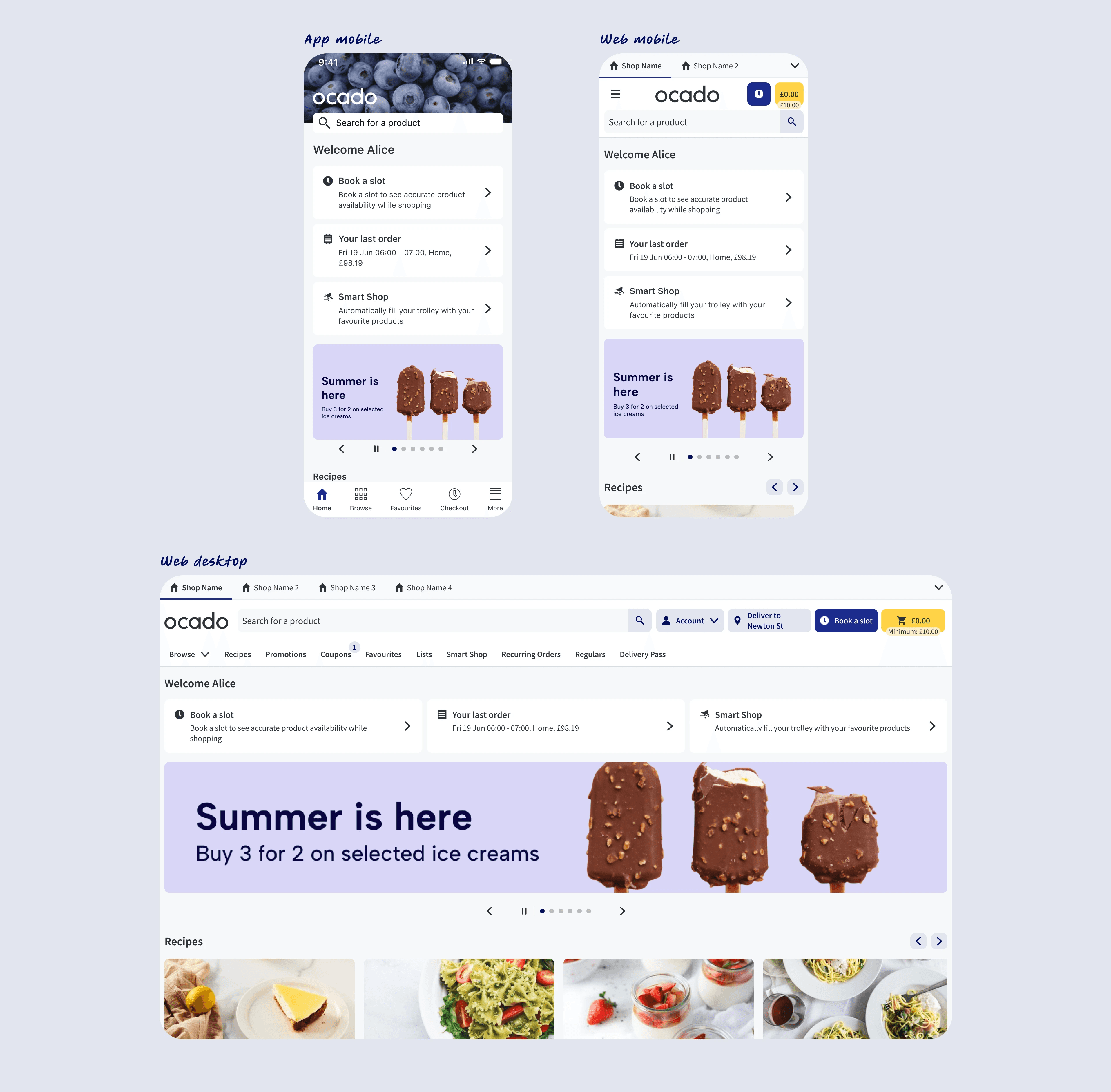
Approach
My role focused on shaping the experimentation process from a UX perspective, defining ways of working, and helping the team adopt hypothesis-driven product development. This included establishing an initial framework, facilitating workshops with partners, and translating insights into testable experiments.
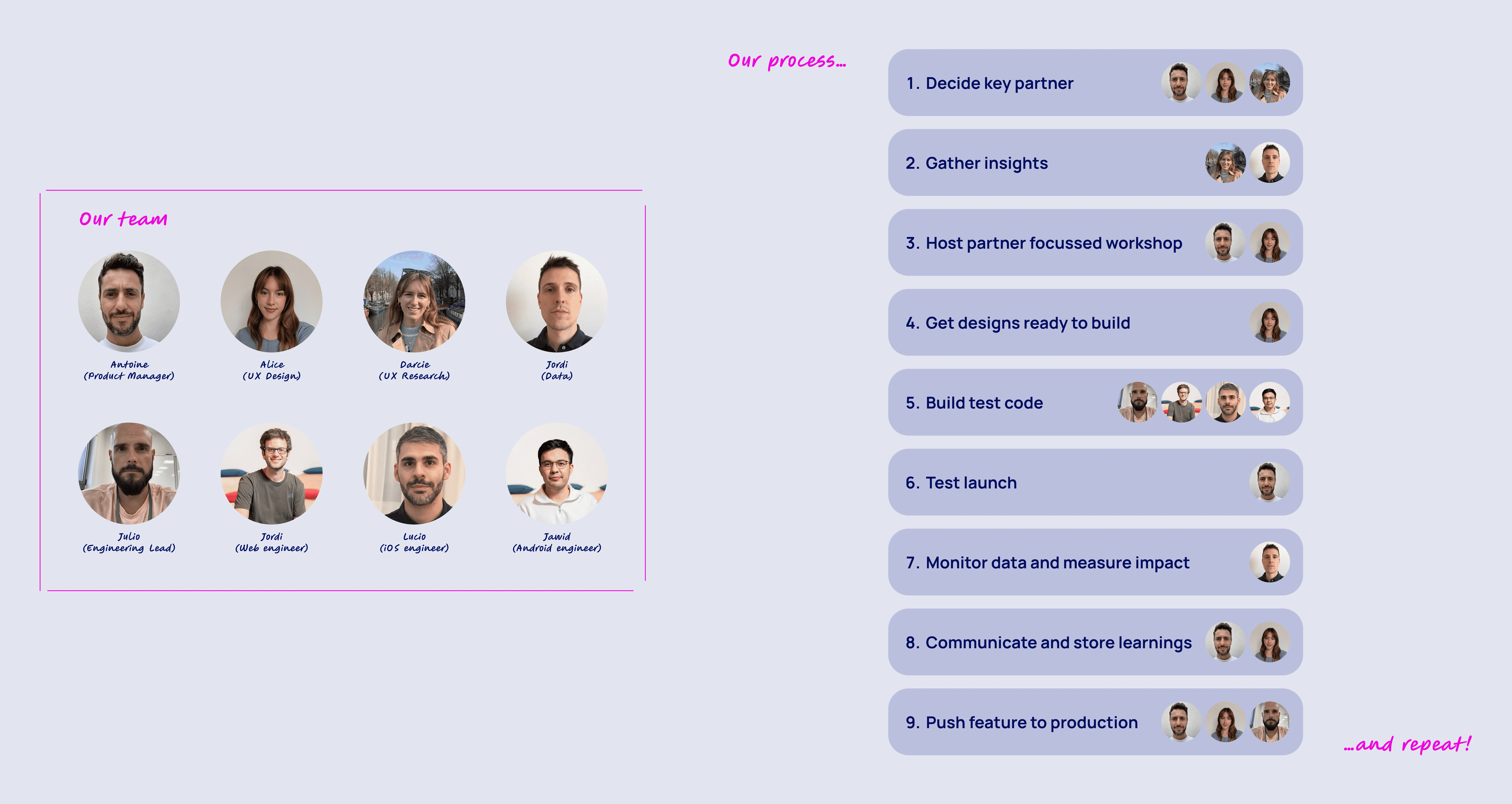
The experimentation team brought together multiple disciplines:
Product
UX Design
User Research
Data
Engineering
Together we defined a shared experimentation framework, including hypothesis writing, prioritisation, experiment design, and success metrics.
A key part of the work was shifting conversations from feature requests to hypothesis-driven problems, helping teams focus on user outcomes rather than stakeholder opinions.
Experimentation Framework
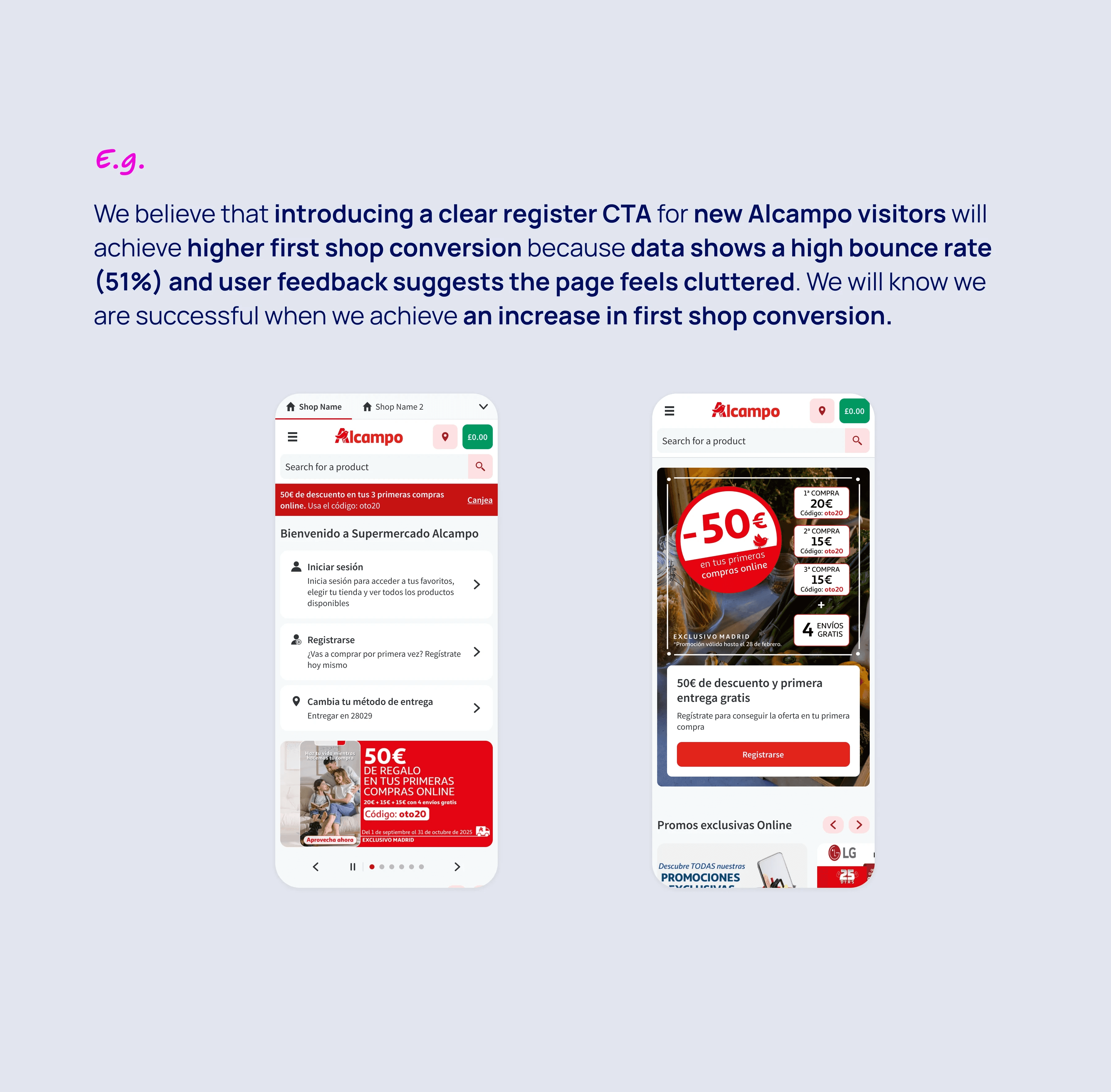
We introduced a lightweight structure for developing tests.
Hypothesis format: Problem → Insight → Outcome
Each experiment clearly defined:
the user problem
the supporting insight
the expected business impact
the success metric
This ensured experiments were focused on measurable outcomes rather than exploratory feature development.
Cross functional Workshops
To generate testable ideas and align partners, we ran intensive workshops with key retail partners. The general workshop format focused on:
aligning stakeholders around key problems
generating hypotheses
designing experiments ready for build
Working in this format allowed us to move quickly. In several cases we generated more testable concepts in a few days than a typical multi-week discovery phase.
It also helped build trust with partners and shift expectations towards learning through experimentation rather than delivering fixed solutions.

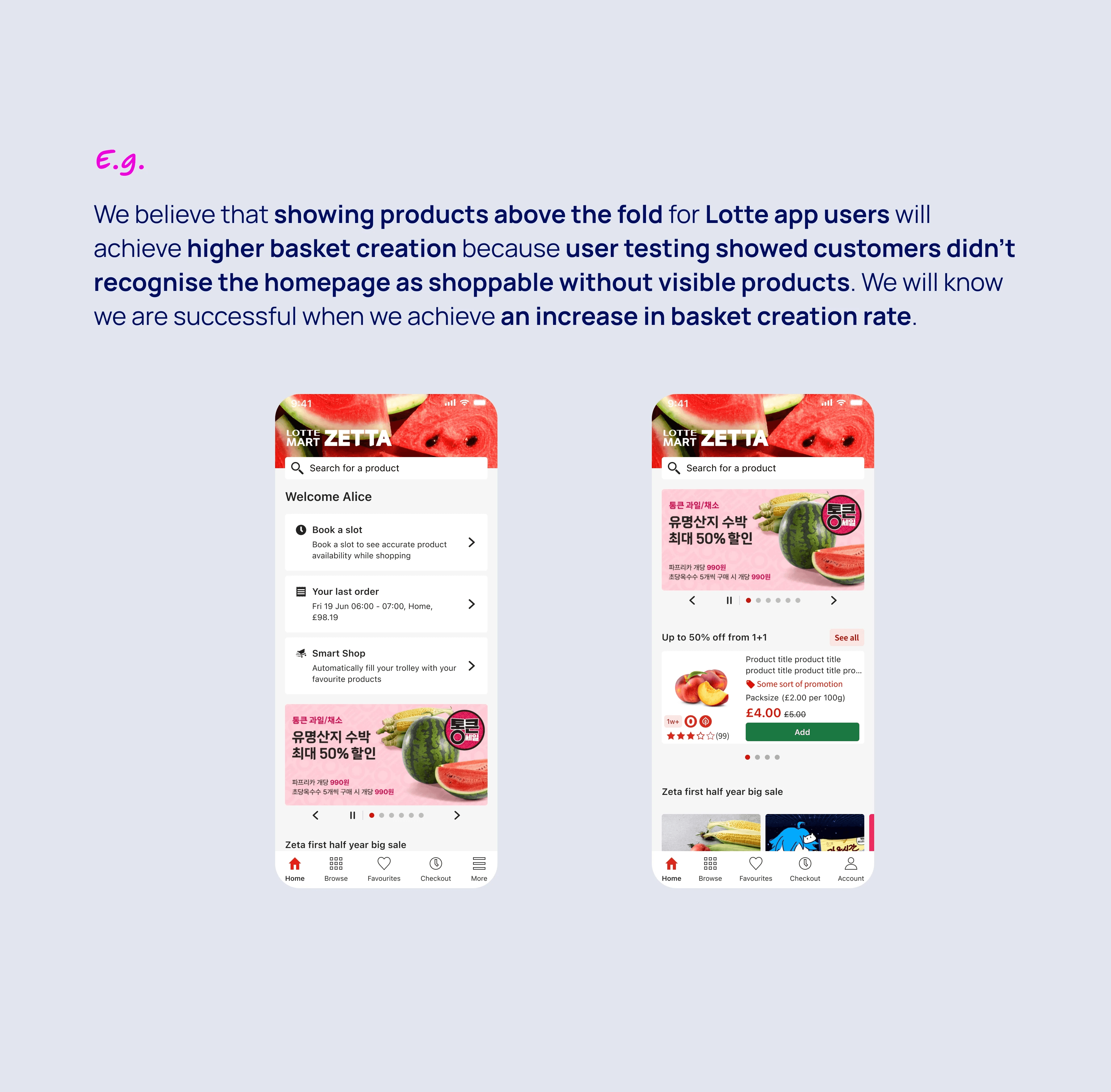
Example test series: Exposing products above the fold
One of the first areas we explored was how the homepage could better communicate that products were immediately shoppable.
Hypothesis
We believe that showing products above the fold for Lotte customers will achieve higher basket creation because user testing showed customers didn’t recognise the homepage as shoppable without visible products. We will know we are successful when we achieve an increase in basket creation rate.
Experiment 1 — Android app (Lotte)
We first tested this on Android, which represented ~90% of Lotte app users, allowing us to validate the concept with the largest user segment. We chose to surface 1+1 promotional products above the fold, since user insights highlighted it as an important promotion to users in the Korean market.
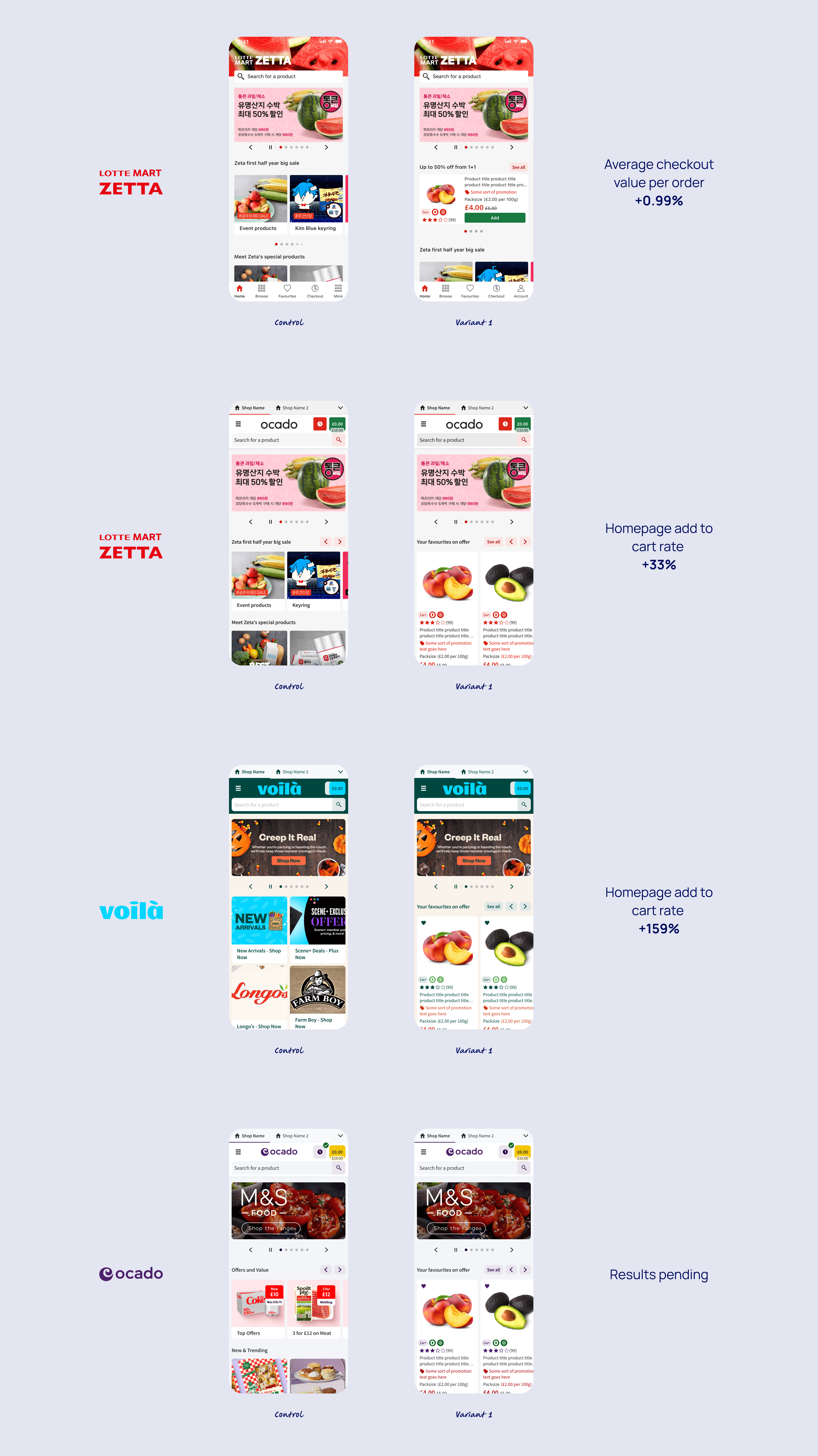
Result: Average checkout value per order +0.99%
Experiment 2 — Web (Lotte)
We then tested a web variant surfacing favourites currently on offer.
Result: Homepage add-to-cart rate +33%
Scaling the experiment
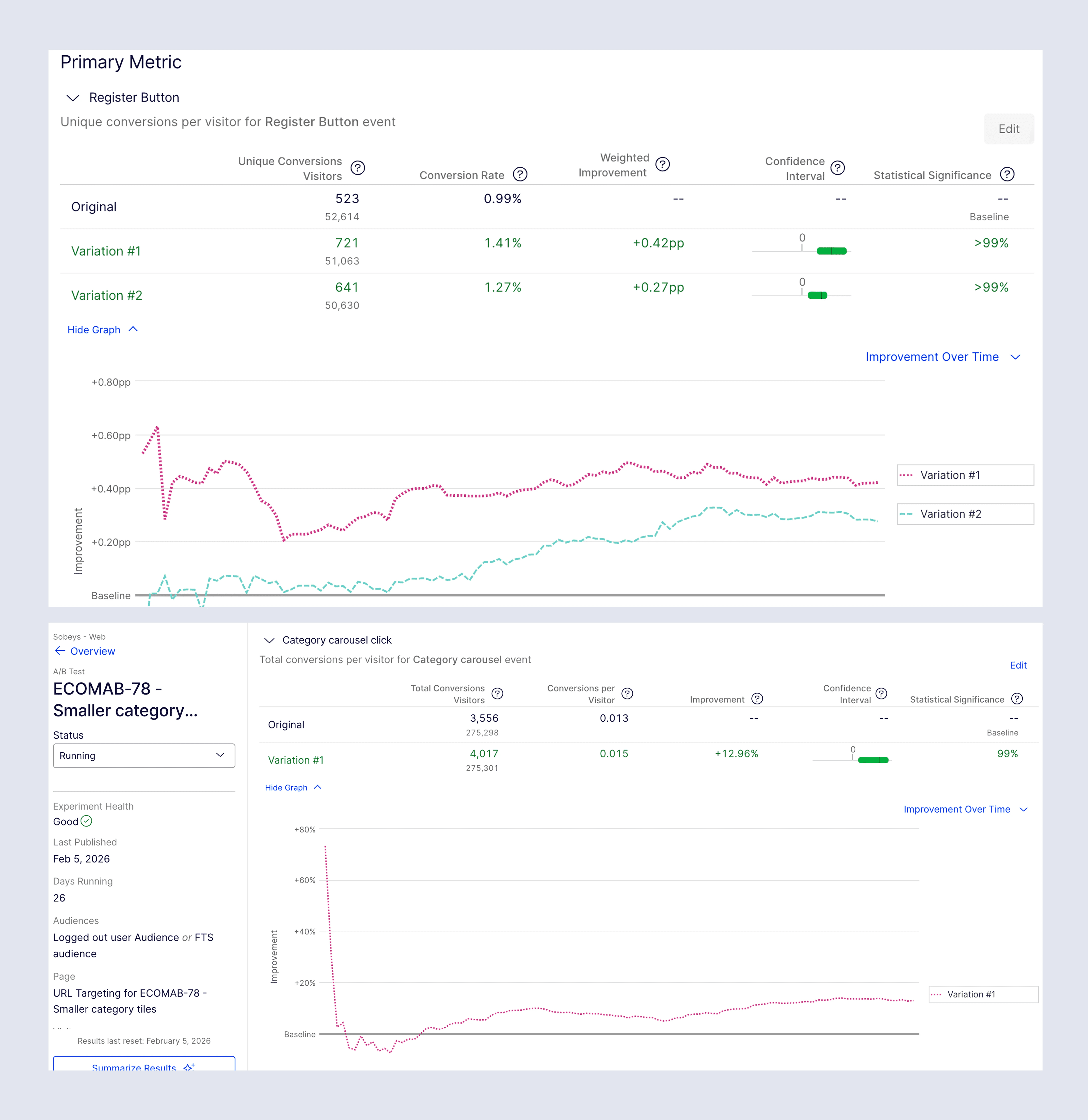
After presenting the results to other retail partners, the concept was adopted by additional retailers. With Sobeys, we expanded the metrics tracked:
Eaches per customer +0.69%
Average checkout value +0.43%
Conversion to checkout +1.40%
Homepage add-to-cart rate +159%
Revenue per customer +2.37%
The experiment has since launched with Ocado, with results pending.
Evolving the Experimentation Process
As the team matured, we refined the approach to become more proactive and insight-led.
User research was brought earlier into the process, ensuring experiments were framed around validated user needs rather than reactive stakeholder ideas. This improved both the quality of hypotheses and the likelihood that successful tests would scale into meaningful product improvements.
The team also established a repeatable experimentation workflow:
Gather insights and identify key partner problems
Develop and prioritise hypotheses
Design and build A/B tests
Measure impact and share learnings
Scale successful ideas into production
This structure allowed teams to move quickly while maintaining confidence in product decisions.
What this unlocks
Evidence-based decisions
Product discussions now centre on validated results rather than stakeholder opinion.Faster learning cycles
Small, iterative experiments allow teams to test ideas quickly and reduce the risk of large product bets.A scalable experimentation culture
The framework and documentation enable other teams to adopt experimentation in their own areas of the product.
Reflection
This project highlighted how important it is to create the conditions for good product decisions, not just better designs.
Before introducing experimentation, many product discussions were driven by stakeholder ideas rather than evidence. Establishing a structured experimentation process helped shift conversations toward user problems, measurable outcomes, and shared learning across teams.
Beyond the individual tests, the most valuable outcome was creating a repeatable way for teams to validate ideas and reduce risk before committing to larger product changes.
For me, the key takeaway was that experimentation is as much about team behaviour and decision-making as it is about testing interfaces. When teams have a clear framework for forming hypotheses, measuring results, and sharing learnings, experimentation becomes a scalable tool for improving the product over time.
Other projects
The "Native Renaissance"
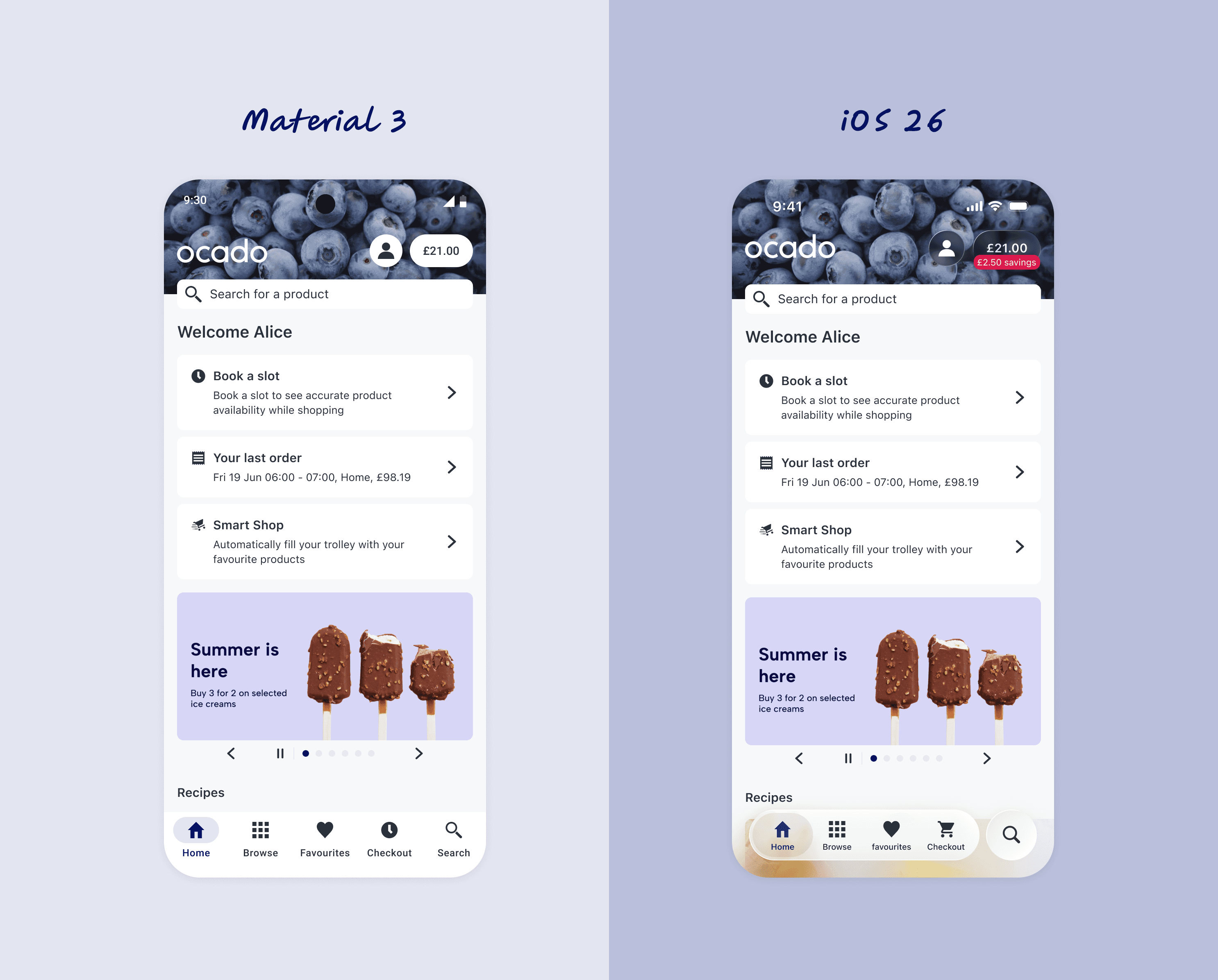
Leading a UX-driven app redesign to replace fragile custom UI with native components, creating a maintainable, cross-platform experience that aligns with the design system and improves usability on iOS and Android.
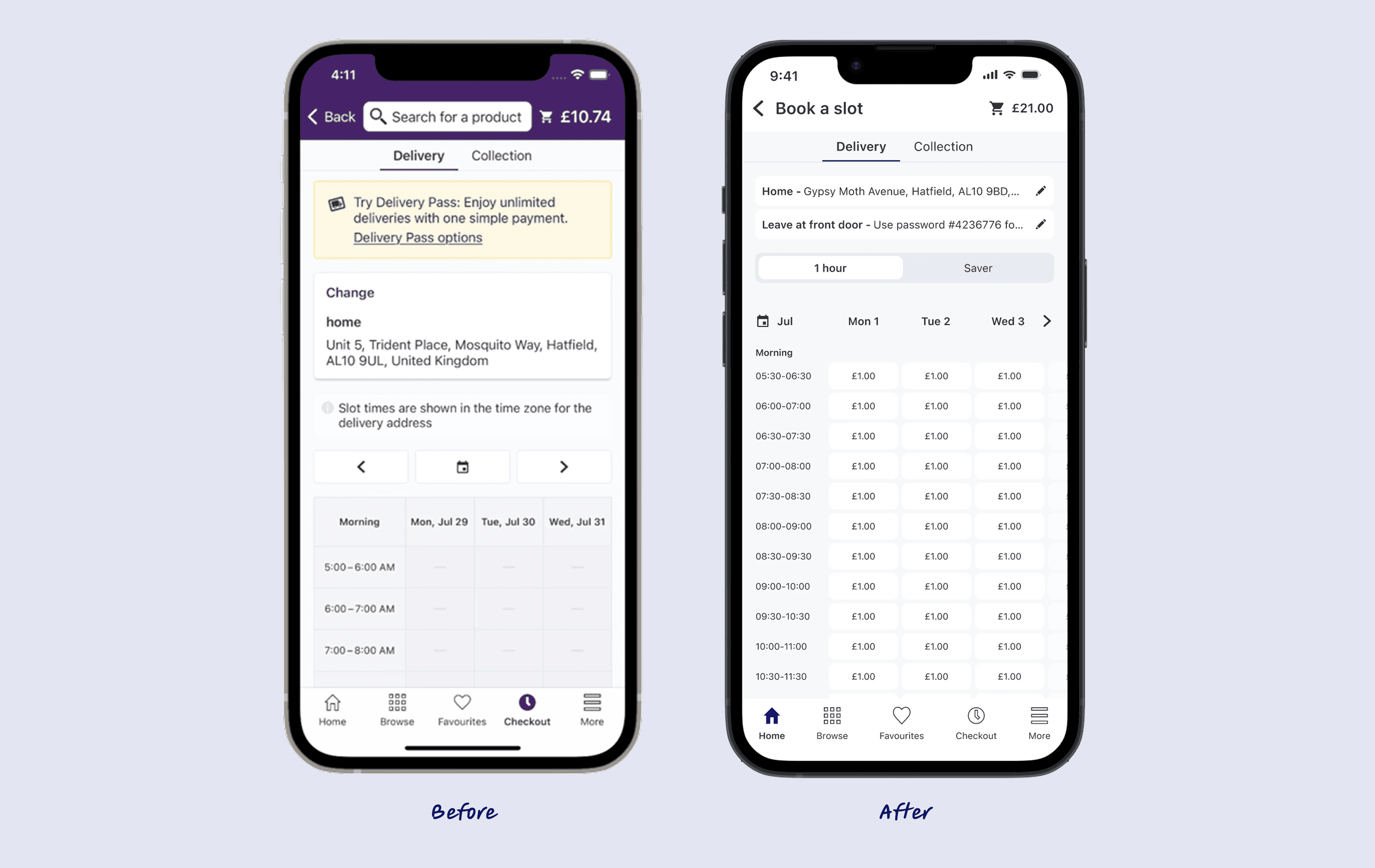
Book a Slot
Driving £3.9M–£16.3M in estimated annual revenue through a redesigned slot booking experience that boosts conversion, clarifies delivery options, and modernises the interface across platforms.